Property owners within the Ripon Consolidated Fire District should begin watching their mailboxes as official ballots are being mailed for the proposed Fire Protection and Emergency Response Services Benefit Assessment.
Property owners within the Ripon Consolidated Fire District should begin watching their mailboxes as official ballots are being mailed for the proposed Fire Protection and Emergency Response Services Benefit Assessment.
The Ripon Consolidated Fire District announced on social media that ballots are being mailed to property owners for the proposed assessment, which, if approved, would create a new annual charge on properties within the district to help fund fire protection and emergency response services.
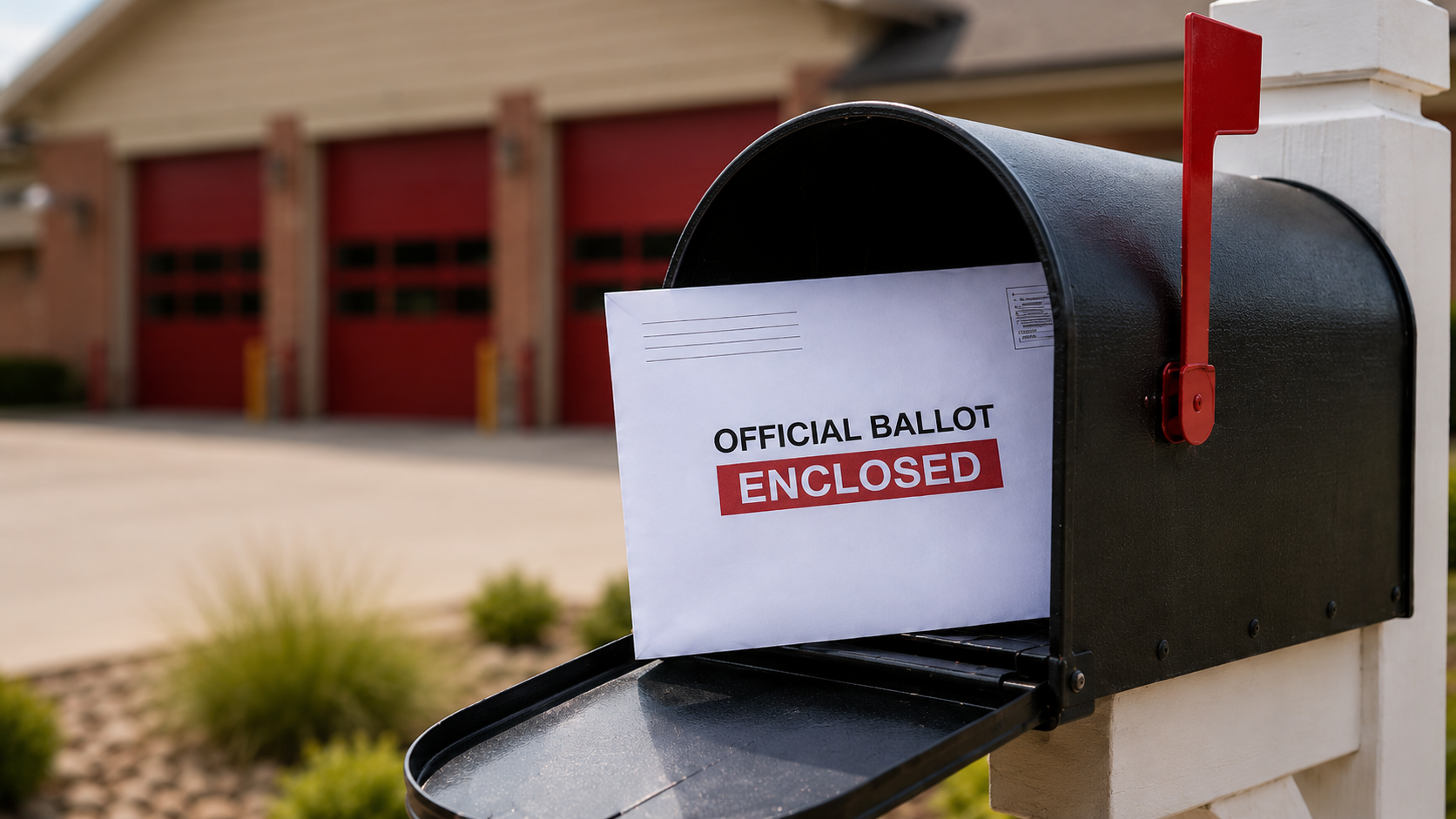
The ballot envelopes will be clearly marked “OFFICIAL BALLOT ENCLOSED.” According to the district, only property owners will receive a ballot. A single ballot may include up to 14 parcels owned by the same property owner. The district said property owners who do not receive a ballot within one week of the mailing date should contact the Fire District for assistance.
This marks the Fire District’s fourth attempt to pass a funding measure to help support additional staffing and fire service needs. The district also noted that in 2024, only 30% of ballots were returned, and officials are encouraging property owners to carefully review the information and return their ballot before the deadline.
What the assessment would fund
According to the Fiscal Year 2026-27 Engineer’s Report, the proposed assessment is intended to provide an ongoing funding source for local fire protection and emergency response services. The report states that the district currently operates one fully staffed station, Station 1 at 142 South Stockton Avenue, while Station 3 at 1705 North Ripon Road remains unstaffed.
If approved, the new assessment would primarily help fund increased firefighter staffing and training, including staffing for a second fire station. It would also support maintenance, repair and replacement of firefighting apparatus, vehicles and emergency response equipment.
The Engineer’s Report says the district covers approximately 56 square miles and serves about 22,500 residents in and around Ripon, including residential neighborhoods, commercial and industrial areas, agricultural land, transportation corridors and areas along the Stanislaus River. The district responds to more than 2,800 calls annually, with the majority involving emergency medical service incidents.
District officials have argued that current revenues have not kept pace with the cost of providing modern fire protection and emergency response services. The report cites increased call volumes, training requirements, fuel, utilities, equipment, insurance and personnel costs as factors contributing to the funding need.
Proposed annual assessment rates
The proposed base rate is $249.98 per Single Family Equivalent, or SFE, for fiscal year 2026-27. The actual amount charged to each parcel depends on the property type, acreage or unit count, and a travel-time factor based on distance from a fire station.
The Engineer’s Report also includes fire hazard zone factors, but Appendix A states that the Ripon Consolidated Fire District currently has no fire hazard areas identified by Cal Fire as a Hazard Zone. As a result, all parcels are assigned a Fire Hazard Zone Factor of 1.
The following estimated annual ranges are based on the report’s base rate of $249.98 and the listed travel-time factors, which range from 1.00 for properties less than five minutes from a station to 0.82 for properties more than 20 minutes away. Property owners should rely on their official ballot for the exact amount assigned to their parcel.
Property Type | Unit Used in Report | Est. Annual Range |
|---|---|---|
Single-Family Residence | Each | $204.98 - $249.98 |
Multi=Family / Condominium | Per residential unit | $88.00 - $107.32 |
Commercial / Industrial | Per half-acre or portion | $378.38 - $461.44 |
Office | Per half-acre or portion | $313.15 - $381.89 |
Storage | Per half-acre or portion | $517.13 - $630.65 |
Parking Lot | Each | $27.08 - $33.02 |
Vacant Parcel | Each | $30.19 - $36.82 |
Non-Irrigated Ag. Land | Per acre or portion | $2.23 - $2.72 |
Irrigated Ag. Land | Per acre or portion | $0.64 - $0.77 |
Rangeland / Open Space | Per acre or portion | $1.29 - $1.57 |
For many homeowners, the most visible number will be the single-family rate of up to $249.98 per year, which equals about $20.83 per month. However, the district’s formula means some parcels may be assessed less depending on travel time and property classification.
Budget impact
The Engineer’s Report lists a total proposed assessment budget of $1,761,404 for fiscal year 2026-27. The largest portion, $1,567,395, is listed for staffing. Other proposed costs include general operations, apparatus and equipment operations, and special department expenses.
The report lists total service needs of $6,404,489. It also identifies $4,644,573 in estimated dedicated revenue from property taxes and other sources, with no county contribution listed. The assessment is proposed to fill the remaining funding gap tied to the enhanced service plan.
If approved, the assessment could increase in future years based on the Consumer Price Index for All Urban Consumers in the West Region, but the annual increase would be capped at 2.85% without another vote or balloting process.
How the ballot process works
This is not a traditional election where every registered voter casts one vote. It is a property-owner ballot process under Proposition 218. Ballots are weighted by the financial obligation of the property. That means the amount a property would pay under the assessment affects the weight of that ballot.
According to the Engineer’s Report, property owners must be given at least 45 days to return ballots after they are mailed. The public hearing is currently scheduled for August 13, 2026, with the hearing expected to continue to August 19, 2026.
If ballots submitted in opposition do not exceed ballots submitted in favor, when weighted by the proposed assessment amount, the Board of Directors may approve the assessment for fiscal year 2026-27 and each year thereafter. If approved, the charge would be placed on the San Joaquin County property tax roll.
The assessment would continue annually unless terminated by the Board, though the district would still be required to prepare updated budgets, assessment rates and assessment rolls each year and hold an annual public hearing to continue the assessment.
What property owners should watch for
The Fire District is asking property owners to watch for the official ballot envelope and review the materials carefully. Property owners should look for an envelope clearly marked “OFFICIAL BALLOT ENCLOSED.”
The district says additional information, including the Engineer’s Report, FAQs and other resources, is available on the district’s website. Questions about the proposed Benefit Assessment or the ballot process may be directed to Fire Chief Eric DeHart, according to the district’s social media post.
Property owners who believe there is an error in the assessment assigned to their property may also file a written appeal with the Fire Chief or designee, according to the Engineer’s Report. The report states that appeals are limited to correcting an assessment during the current fiscal year.
With ballots now being mailed, the Fire District is urging property owners to participate in the process and return their ballot before the deadline.